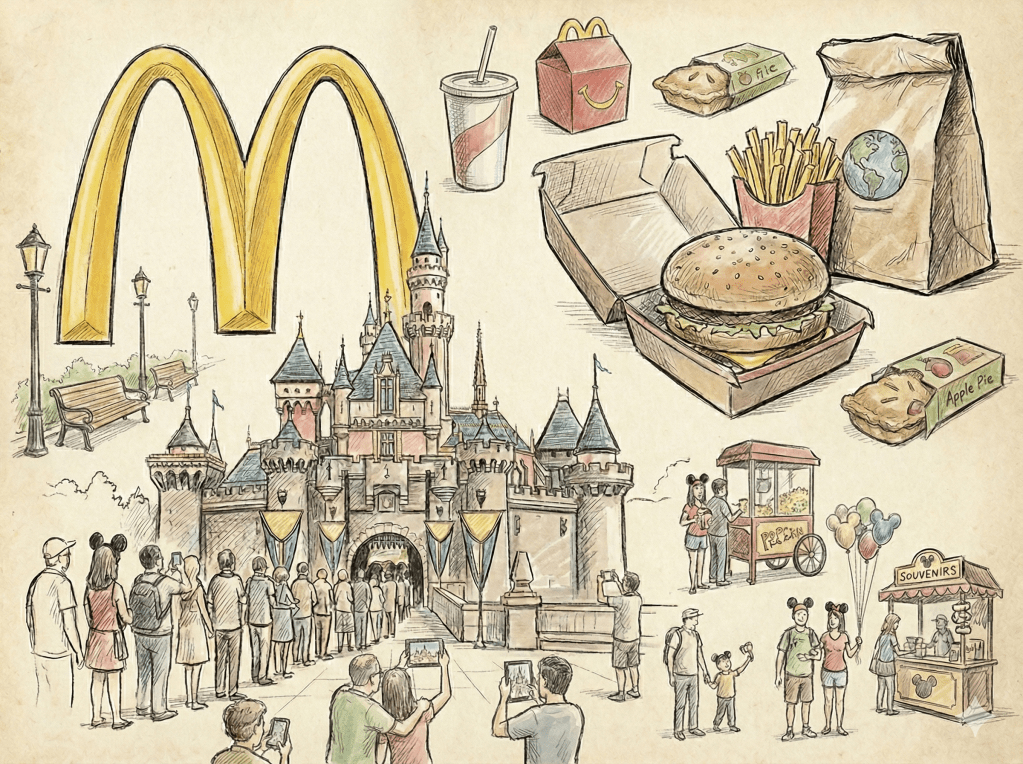
Reading Response: McDisneyization and Post-Tourism (George Ritzer & Allan Liska)
This is a compelling and intellectually rich paper. While I acknowledge and respect its critical stance, I observe a recurring tendency to frame enterprises such as McDonald’s and Disney—and, by extension, modern, successful business models—primarily as detrimental to broader social and cultural life. Although this critique is often justified, I approach the discussion by reflecting on the authors’ arguments from an alternative perspective, without dismissing the substantive truths they present.
Several points in the article warrant closer reflection:
- The text appropriately recognizes certain positive contributions of Disney, particularly in relation to its capacity to manage large populations and coordinate highly complex organizational and operational systems.
- The argument that an increasingly “McDonaldized” society requires rigidly standardized tourism packages may be contestable. As standardized products become ubiquitous across global destinations, tourists may encounter familiar “McDonaldized” experiences almost anywhere, whether through McDonald’s itself or local equivalents (for example, localized versions of the “Mc” concept in diverse cultural contexts).
- The classification of tourists as primarily seeking vacations that are highly predictable, efficient, calculable, and controlled is persuasive for a significant segment of the tourism market. However, this typology appears less applicable to other forms of tourism, such as adventure travel or elite and luxury tourism, where financial security, risk, and exclusivity may shape very different motivations and expectations.
- The historical observation that both Disney and McDonald’s emerged in 1955 as business models rather than as deliberate social projects is important. While their societal impacts merit critical scrutiny, these effects should be considered alongside their positive contributions and within the broader context of global social and economic transformations already underway.
- The example of non-McDonaldized tourism, such as mountain climbing, illustrates a form of travel that resists standardization and engages dimensions of experience that typical touristic packages and conventional tourists may not prioritize.
- The article raises, but does not fully resolve, the question of whether digital technologies, such as the internet and virtual reality, stimulate physical travel by inspiring exploration, or whether they function as substitutes that offer controlled and simulated experiences in place of direct engagement with place.
The concluding remarks of the article are especially thought-provoking, particularly the assertions that there are no grand conclusions to be drawn, no definitive truths to uncover about contemporary tourism, and that social theorists have strong reasons to remain modest in their claims. These statements effectively reinforce the complexity, contingency, and open-ended nature of tourism as both a social practice and an object of academic inquiry.