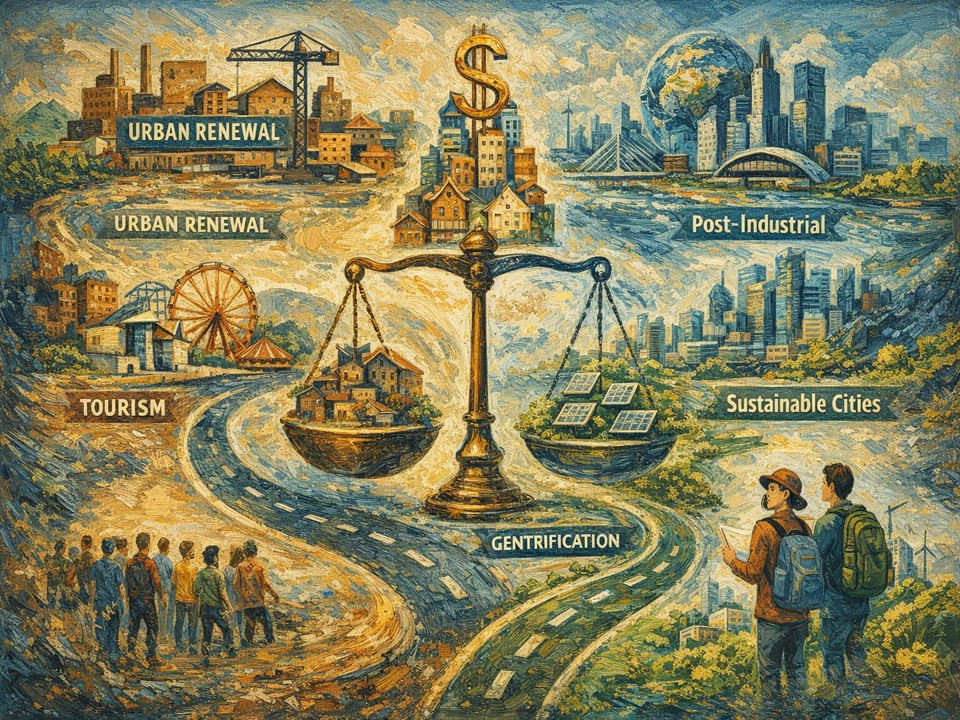
Landscape architecture and planning are both outcomes and drivers of societal dynamics, shaping the spaces we inhabit while simultaneously reflecting broader social, economic, and cultural processes. Despite this interconnection, tourism studies have historically overlooked the urban and landscape contexts, while urban studies have often underestimated the role of tourism in shaping city life. This gap has left the intersection of tourism and urbanism comparatively under-researched, highlighting the need for a more integrated perspective.
Historical Lessons: 1960s–1970s
The evolution of tourism within cities can be traced back to early industrial-era dynamics. Thomas Cook, often cited as the originator of modern tourism in 1841, is sometimes criticized for fostering mass tourism, although this assessment ignores the different scales and parameters of the period.
Cities with established urban centers naturally attracted visitors, yet many struggled as industrial decline set in. Efforts at urban renewal, aimed at reducing crime and revitalising declining neighbourhoods, often failed in both the UK and the USA due to misaligned strategies and socio-economic complexities.
Successful revitalization typically depended on public-private partnerships (PPP), whereby city officials collaborated with private actors to repopulate and energize city centers. Strategies included promoting festivals, sporting events, and cultural attractions. While these interventions brought economic gains and redefined city centres as tourist hubs, with shopping malls, hotels, historic sites, stadiums, and aquariums, the initiatives often displaced long-standing, especially low-income, residents. Heritage sites, industrial facilities, and transportation infrastructures were repurposed for tourism, demonstrating the sector’s potential to reuse urban fabric while enhancing economic and cultural vibrancy.
Urban planning also recognized the importance of scale and design: more people generally made places safer and more attractive, while careful landscape management, street furniture, and spatial organization could guide visitor behavior. However, these measures were not universally scalable and required context-specific planning.
Post-Industrial Economies: 1980–1990s
As public funding for urban development declined, the reliance on PPP grew, particularly in rapidly urbanizing and economically booming regions in Asia. Cities increasingly integrated tourism into their broader recovery and development plans.
Mixed Success
Some cities succeeded in leveraging tourism as a driver of urban revitalization, while others struggled, revealing the mixed outcomes of tourism-centered strategies. Political shifts, including rising expectations for personal freedom and critiques of government intervention, also transformed public planning, facilitating greater private sector involvement.
This era marked a shift from production-based economies to consumption-driven models, supported by new telecommunications technologies and the expansion of business travel. Cities competed within a globalized market, striving to provide superior amenities and services while simultaneously navigating the interface of rural, urban, and cultural landscapes.
New Models of Urban Tourism
Modern city planning increasingly relies on the negotiation skills of mayors and urban leaders, balancing city master plans against commercial interests. Cities now actively market themselves globally, responding to sophisticated consumer preferences that demand unique, engaging, and memorable experiences. Urban identity and branding have become central, blending global visibility with local heritage, culture, and traditions. Tourist landscapes are thus shaped by the intersection of global and local dynamics, often opportunistic yet occasionally conflicting.
Tourism has fostered diverse forms of urban development: boutique hotels, heritage conversions, museums, theaters, performing arts centers, themed malls, and destination developments that unfold curated experiences for visitors. Iconic examples like the Bilbao Guggenheim illustrate the “civic catalyst” effect, where architecture elevates city recognition. At the same time, mega-malls and theme parks exemplify destination development from scratch, providing choice and spectacle but also redefining urban spaces.
Distributive Justice and Urban Challenges
The expansion of tourism can create tension between visitor-oriented and resident-oriented spaces. Infrastructure stress, social segregation, and economic costs often disproportionately affect local communities, while benefits are more likely captured by investors or private actors. Overemphasis on tourism can erode the authenticity of heritage sites and marginalize ordinary urban life. Effective planning therefore requires attention to multi-functionality, scale, typology, and design, alongside careful consideration of resource allocation to balance economic, social, and cultural benefits.
Theoretical and Methodological Considerations
Urban tourism research remains under-theorized, often descriptive and conceptually chaotic. Key challenges include understanding the complex interactions between urban form, tourism dynamics, and social behavior. Future research should consider distributional equity, multi-functionality, urban space typologies, catchment areas, and the sensory experience of urban spaces, which are crucial for both residents and visitors.
Future Directions and Sustainability
Tourism-driven urban development will continue to generate both opportunities and challenges. Social justice, local-global dynamics, and the impact of digital technologies must inform planning. Cities are increasingly embracing sustainability through green practices, LEED certification, and attention to environmental costs associated with travel and luxury facilities. Understanding the full spectrum of tourism’s economic, social, and environmental impacts remains essential for fostering resilient, inclusive, and vibrant urban spaces.