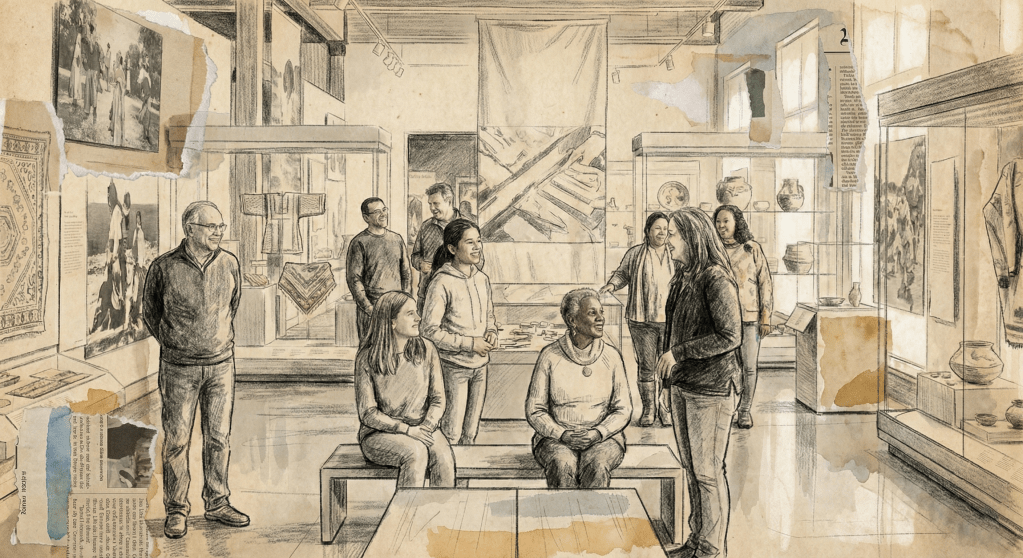
The enduring question of how many angels can dance on the head of a pin reminds us that culture has always balanced between the abstract and the tangible, between what can be measured and what can only be imagined. This tension lies at the heart of how societies understand heritage. Museums, for instance, are not merely repositories of objects; they are concentrated expressions of memory, identity, and meaning. In many ways, tourism transforms the entire world into a dispersed museum, while the museum itself becomes a condensed journey through time and space. From the fragments of the past, we are constantly constructing visions of the future, shaping what we choose to preserve, display, and pass on.
What we inherit from our families extends far beyond land, photographs, or physical possessions. We also receive interests, tastes, habits, and styles—intangible forms of heritage that quietly influence how we see the world. Figures such as the “nani,” who contributes to a child’s upbringing despite not belonging to the same social class, demonstrate how cultural transmission often occurs across boundaries. As Churchill once observed, people may grow within rigid social structures, yet later in life seek connection beyond their own class. These encounters with the “other” begin early: from the intimate circle of mother and child, to family, extended family, friends, and eventually to those outside one’s culture entirely. In Europe, for example, gypsies historically represented one of the first visible “external others,” shaping early notions of difference and belonging.
Heritage and identity are also deeply reflected in how societies define boundaries—whether between people, cultures, or even species. Attitudes toward animals, food, and marriage reveal systems of rules and values that determine what is considered acceptable, sacred, or forbidden. Similarly, the way we view our own heritage has expanded. We no longer look only at what is “ours,” but increasingly at what belongs to the world. This global perspective parallels the idea that one can form connections beyond national or cultural lines, extending the concept of inheritance both vertically and horizontally. Patrimony represents what is received from one’s lineage, while matrimony symbolizes what is added through contact with other cultures.
Yet, this sense of ownership over heritage can lead to conflict. People often feel entitled to protect, label, or control cultural assets simply because they inherit them. The controversy surrounding the Taliban’s destruction of the Buddha statues, despite international offers to preserve them, highlights how heritage can become a site of political and moral confrontation. Culture does not emerge only in moments of harmony; it becomes visible in conflict, in rules and regulations, and in the predispositions that shape collective behavior. Even the desire to travel—to cities like London or Paris—is often cultivated through education, media, and social aspiration, reinforcing the link between culture and class.
Globalization has multiplied the options available to individuals, offering choices and possibilities that previous generations could scarcely imagine. The same cultural impulses that motivate people to visit friends and family also drive tourism; one must first develop a cultural understanding of a place in order to desire seeing it. This is why certain sites, such as the Mystery Spot, attract visitors not merely for what they are, but for the stories and meanings attached to them. Travel, like heritage, is ultimately about curiosity, connection, and the ongoing negotiation between what is familiar and what lies beyond.