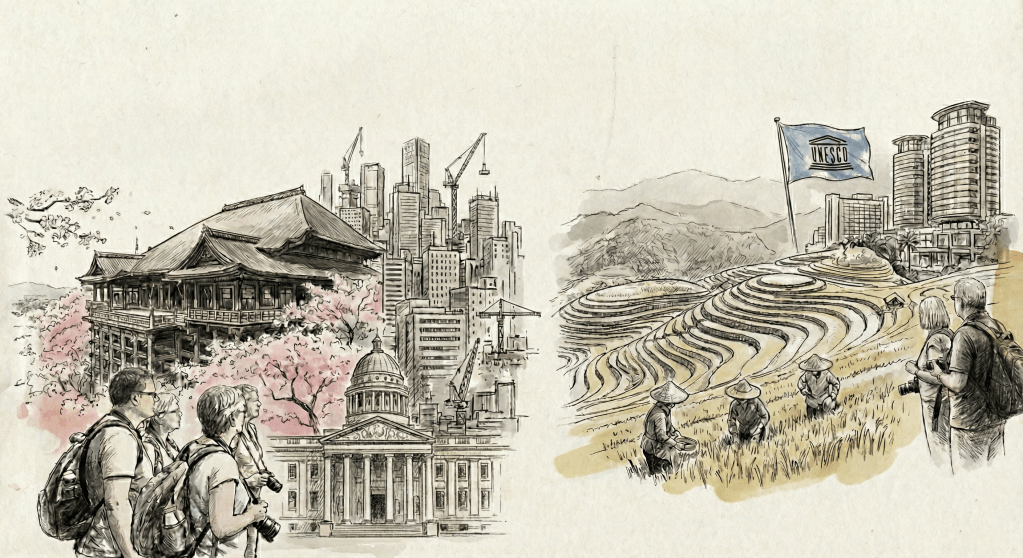
The case of the Kyoto temple illustrates how heritage sites can become deeply entangled with modern urban governance and economic systems. When the city demanded tax collection from the temple, the institution responded with a form of protest that disrupted the tourism economy, resulting in the loss of an estimated five to ten million visitors. This incident highlights the significant leverage that cultural and religious landmarks can hold within contemporary cities, where heritage is not only a spiritual or historical asset but also a major economic driver. It reveals the tension between state authority and cultural institutions, as well as the vulnerability of urban economies that rely heavily on tourism.
The concept of coding and decoding emphasizes the gap that often exists between those who construct messages and those who receive and interpret them. Governments, religious institutions, and other powerful actors typically act as “encoders,” shaping narratives, symbols, and policies with particular intentions. Tourists, citizens, or broader audiences function as “decoders,” interpreting these messages through their own cultural, social, and personal frameworks. Frequently, the encoders fail to consider how their messages may be misunderstood or reinterpreted, sometimes with serious consequences. Historical examples demonstrate how miscommunication and misinterpretation can lead to conflict, reinforcing the importance of understanding audience perspectives in the production of meaning.
History is often shaped by individuals and groups who were not directly part of the lived experiences they document. Scholars, historians, and intellectual elites frequently determine what is remembered, preserved, and taught, while other narratives are marginalized or erased. This dynamic reflects broader class and power differences, where authority over memory becomes concentrated in the hands of those with access to education, institutions, and publishing platforms. As a result, history is not merely a neutral record of the past, but a curated and selective process that reflects the values and priorities of those who control its production.
The implementation of a centralized education system in France demonstrates how national identity can be actively constructed through institutional frameworks. By standardizing language, curriculum, and cultural references, the state sought to foster a unified sense of “Frenchness” across diverse regions, including communities in the south with distinct linguistic and cultural traditions. Education became a tool of integration and assimilation, shaping how citizens understood themselves and their relationship to the nation. This process illustrates how schooling can serve not only as a means of knowledge transmission, but also as a powerful instrument of cultural and political alignment.
Certain regions and communities are often defined by external narratives that prescribe both who they are and what roles they should play. These representations can emerge from government policies, tourism industries, or international institutions that frame places in specific ways, such as cultural destinations, heritage zones, or areas of economic development. Over time, these labels can limit local agency by encouraging communities to conform to imposed identities rather than pursue their own aspirations. This process underscores how spatial and cultural identities are not simply organic, but are frequently shaped by broader systems of power and representation.
Decisions about what qualifies as “world heritage” are typically made by a relatively narrow group of international experts and upper middle-class professionals who may be disconnected from local realities. While these designations are intended to protect and celebrate cultural and natural sites, they can override the voices and priorities of the communities who live within or around them. In some cases, local residents resist heritage classification because it restricts their livelihoods, land use, or development opportunities. This tension reveals the complex relationship between global recognition and local autonomy in the governance of heritage.
The preservation of agricultural terraces in China offers a clear example of how global heritage goals can conflict with local desires. International organizations may view these landscapes as cultural treasures that must be protected for humanity, while the communities who built and maintained them may aspire to leave rural life in search of urban opportunities and retirement in cities. For these residents, heritage designation can feel like an obligation to remain tied to labor-intensive traditions rather than a benefit. This situation highlights how well-intentioned preservation efforts can sometimes work against the social and economic mobility of local populations.
Memory is not only stored in written records and archives, but also embedded in everyday habits, gestures, and traditions that are passed down through generations. As societies develop more advanced systems of public archiving and documentation, the quantity of recorded memory increases. However, this process can flatten lived experiences into standardized and less emotionally meaningful forms. While archives preserve information, they may fail to capture the intimacy, nuance, and embodied knowledge that make memory deeply personal and culturally rich.
The idea of intimacy with the “fake” reflects the phenomenon of staged authenticity in heritage and tourism. Visitors are often drawn to carefully constructed experiences that simulate cultural practices, historical settings, or traditional lifestyles, even when they are aware that these presentations are curated or artificial. Over time, emotional connections can form with these representations, blurring the line between genuine cultural engagement and performance. This dynamic raises questions about what authenticity means in a world where heritage is increasingly mediated and designed for consumption.
Heritage and history function differently as products of the past. Heritage often operates as a commercialized form of memory, packaged and marketed for tourism, branding, and economic development. History, by contrast, tends to serve as a political product, shaped by institutions and authorities to support particular national, ideological, or social narratives. Together, they demonstrate how the past is not simply remembered, but actively produced, managed, and deployed in contemporary contexts.
The growing commercialization of heritage has begun to erode the perceived integrity of the concept itself. As cultural sites, traditions, and narratives are increasingly treated as commodities, their symbolic and social value can become overshadowed by their economic potential. This shift risks reducing complex histories and living cultures into simplified, marketable images designed to attract consumers rather than foster understanding. In this way, the reputation of heritage is challenged by the pressures of mass tourism and global consumption.
Museums gained prominence in the nineteenth century as part of broader movements toward public education, national identity formation, and cultural awareness. They were increasingly seen as institutions that could make knowledge accessible to wider audiences and promote shared understandings of history, science, and art. Prior to this period, collections and cultural artifacts were largely confined to royal courts, private collectors, and elite circles. The transformation of museums into public institutions reflects a shift toward democratizing access to knowledge, even as questions remain about whose stories and perspectives are most prominently displayed.