Anthropology has evolved beyond the study of small or isolated societies into a complex and wide-ranging discipline that engages with global social, cultural, and psychological processes. The notion of “otherness” is no longer limited to distant or unfamiliar groups but is examined across sociopsychological, sociocultural, and temporal dimensions. However, the discipline has often been shaped by perspectives rooted in the Global North, particularly through historically dominant Western viewpoints. This positionality places a significant ethical and intellectual responsibility on anthropologists, who must approach societies and cultures with care, reflexivity, and a commitment to seeking deeper forms of truth before forming professional judgments.
The expansion of urban centers, intensified resource exploitation, and the transformations brought about by the world wars generated both material progress and a collective sense of nostalgia for earlier ways of life. Global movement through tourism and migration has become a central lens for understanding cultural difference, shaped by historical patterns of colonialism and unequal power relations. While the world can be seen as increasingly fragmented and diverse, tourism also contributes to a form of cultural homogenization, as similar experiences, services, and environments are reproduced across different destinations.
Postmodern conditions have further influenced how history and culture are experienced, often emphasizing surface-level products and experiences, diminishing the perceived depth of historical narratives, and encouraging the replication of the past in non-authentic or staged forms. Reproduction technologies such as photography and mass production have weakened traditional notions of authenticity by making copies widely accessible and indistinguishable from originals. As a result, both tourists and entrepreneurs increasingly recognize the “staging” of authenticity, prompting visitors to either seek experiences beyond the surface or knowingly participate in curated cultural performances.
Tourism has become one of the largest and most influential global industries, surpassing many traditional sectors such as petroleum and communications. Its modern form was shaped by technological and social developments, from the democratization of travel initiated by figures like Thomas Cook in the nineteenth century to the transformative impact of automobiles and jet travel in the twentieth century. These innovations allowed people to travel more freely, independently, and across greater distances, expanding tourism beyond elite groups to the global middle class and across national boundaries.
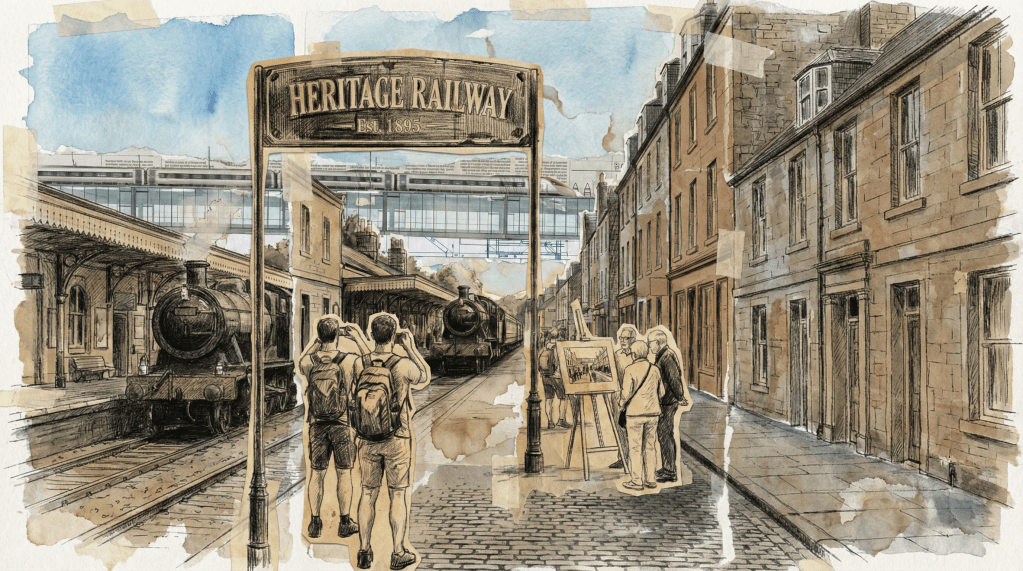
Nostalgia plays a powerful role in driving tourism and conservation efforts, motivating people to reconnect with personal pasts, idealized histories, and imagined cultural identities. This can take the form of revisiting childhood places, engaging in activities associated with youth, or expressing a form of imperial or social-class nostalgia. At the same time, tourism can lead to the “museumization” of culture, where living traditions are preserved, packaged, and displayed as static representations for consumption.
Despite its challenges, tourism offers tangible benefits to local communities by generating income and creating incentives to preserve natural and cultural landscapes, such as wildlife regions in East Africa or agricultural terraces in Southeast Asia. However, it also reinforces inequalities between hosts and visitors, particularly in terms of mobility and access to global experiences. The emergence of “hyper-reality,” where reproduced or themed environments can appear more appealing than their original counterparts, further complicates the relationship between authenticity and cultural representation.
As globalization accelerates, some scholars question whether increasing cultural similarity reduces the motivation to travel. Yet, tourism continues to grow, suggesting that even in a more homogeneous world, the desire for difference, experience, and connection persists. Anthropologists, positioned as both observers and participants in these transformations, play a critical role in interpreting how tourism reshapes social relations, cultural meanings, and the global distribution of power and opportunity.