Britain Is Different Because It Did Not Have a Revolution
Unlike many European nations, Britain avoided large-scale social and political revolutions that dramatically reshaped its society. This relative stability allowed for gradual institutional change and a continuity of traditions. The absence of a violent rupture meant that certain social structures, cultural norms, and governance practices evolved more incrementally, influencing both domestic life and the administration of its colonies.
Colonial Governance: Autonomy Within the Empire
Many British colonies experienced a degree of local autonomy under British rule. The British often preferred to have existing local rulers maintain control, provided they aligned with imperial interests. This approach minimized administrative disruption while reinforcing economic and political influence, allowing colonial systems to retain elements of indigenous governance and tradition.
Tradition and the Documentation Milestone of Photography
The invention of photography marked a turning point in the recording of tradition. Traditions that existed long before the 19th century became more visually documented and widely disseminated. However, there is a common misconception that photography represents the beginning of tradition; in reality, European societies had extensive written records of customs, rituals, and cultural practices long before photographic technology existed.
Nations Fight to Preserve Their Traditions
Historical encounters with foreign powers often forced nations to protect their cultural identity. For instance, in 1642, Japan resisted European influence, particularly from Portuguese missionaries, demanding that converts renounce Christianity, leave the country, or face execution. The Dutch, who were allowed to trade, complied with Japanese orders to eliminate European Catholics, resulting in 30,000 deaths. Despite these conflicts, Japan selectively adopted foreign knowledge, such as medicine from the Dutch. By 1853, Japan was compelled to open its ports to international trade, initiating a new era of cultural interaction.
Factors Impacting Tradition
a) Technology
Technological advancements have profoundly influenced tradition. Innovations such as long-distance sailing expanded trade and colonisation opportunities, while economic incentives often underpinned imperial power. The Catholic Church’s restrictive stance on science initially slowed intellectual progress, yet inventions like the telescope advanced both practical knowledge and the pursuit of understanding the universe.
b) Archaeology
Archaeology connected Europe with Eastern civilisations, leading to a rediscovery of Greek, Roman, and Arab heritage. These findings shaped European perspectives on history, culture, and the continuity of civilisation.
c) Science and Universities
Universities emerged as centres of knowledge transfer. Initially under ecclesiastical authority, they evolved into independent institutions that disseminated both theoretical and applied knowledge, bridging cultural and scientific gaps across regions. Science pursued both curiosity-driven knowledge and practical solutions to societal challenges.
Progress and Modernity
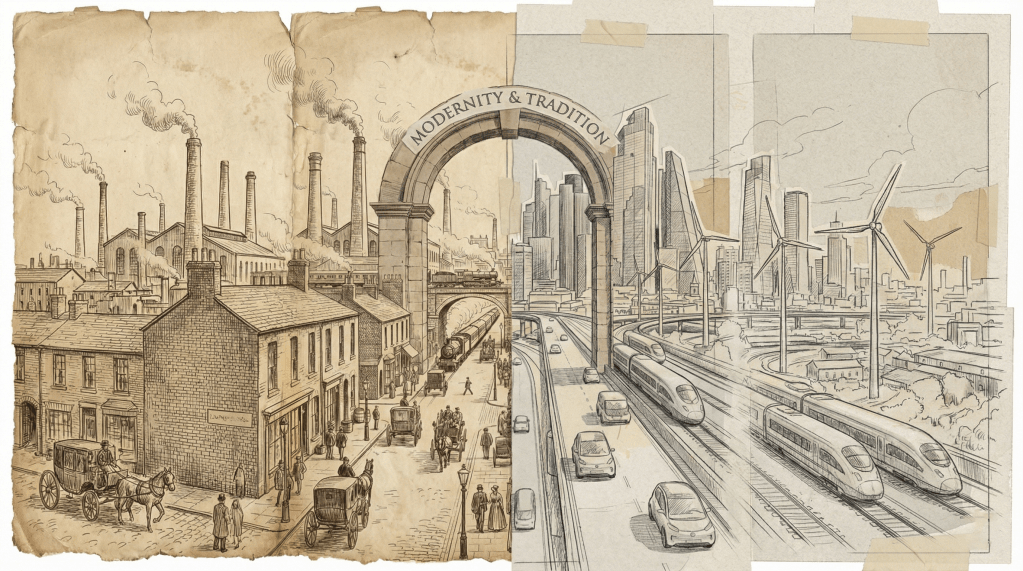
The notion of progress varies depending on perspective. It can manifest as the expansion of the British Empire, improvements in healthcare, or technological advancements. Modernity often casts tradition as outdated, making traditional practices appear expensive or inefficient. Museums and evolutionary frameworks provide tools to preserve and measure traditions within the context of modernization. However, progress is not always linear, and its benefits may not be universally experienced.
Post-Colonial Identity
Post-colonial nations often grapple with defining their identity. They seek to differentiate themselves both from the former colonial power and from neighboring countries that shared similar colonial experiences. Sources of identity include ancient civilizations, unique natural landscapes, and historical events that shaped national consciousness, for example, the 1812 Canadian victory over the United States is more celebrated in Canada than in America. Colonial interactions also influenced social hierarchies, as missionaries emphasized the humanity of indigenous peoples while colonial administrations often sought to exploit them.
Industrial and Technological Developments
The Industrial Revolution and related technological advancements had far-reaching effects on society and tradition. Steam power enabled deep mining operations, while early public transportation, such as the horse-driven metro in London, reshaped urban life. The Enclosure Act in 18th-century Britain consolidated small landholdings into large estates, displacing peasants and fueling urban labor for industrial growth.
War, Progress, and Human Cost
Technological and medical advancements played critical roles in the world wars. Weapons of the Industrial Revolution enabled mass casualties during the Civil War, while World War I saw the widespread use of advanced weaponry and medical interventions, though pandemics like the Spanish flu caused millions of deaths. In World War II, medical progress mitigated some casualties, though targeted atrocities, such as the Holocaust, underscored the human cost of war.