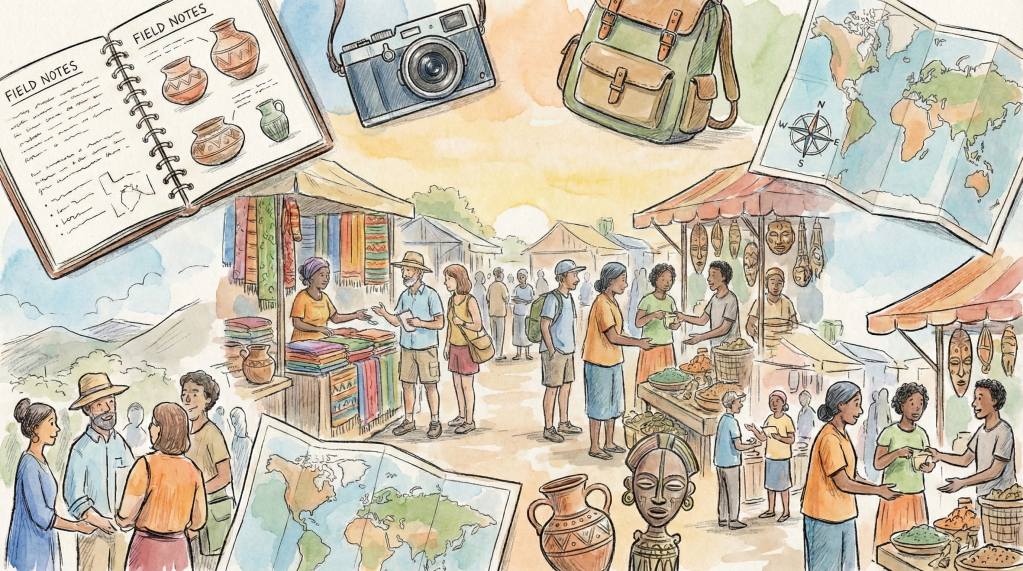
Anthropological Approaches in Tourism Studies
Anthropologists studying tourism often employ immersive research methods to understand its social and cultural dimensions. Common approaches include participant observation, joining tours, and residing in destinations for extended periods, sometimes several months. These methods allow researchers to capture the lived experiences of both tourists and host communities, providing insight into how tourism shapes everyday life, economic practices, and social interactions.
Defining Tourism
Tourism is a complex phenomenon encompassing multiple roles and meanings. It can be understood as a category of experience distinct from everyday routines, offering personal enrichment and employment opportunities. Tourism also functions as a driver of social change, a medium for cultural representation, and a channel of globalization. However, its economic benefits are often unevenly distributed. While tourism can support national development, leakage of resources frequently benefits Western countries more than host nations.
Positive Impacts of Tourism
Tourism provides tangible benefits to local communities. It generates employment, reinforces cultural practices, and can reduce rural-to-urban migration by offering sustainable livelihoods in rural areas. The production of tourist art illustrates this impact: prior to the 1960s, crafts primarily served local needs, but contemporary artisans increasingly produce items for both residents and visitors, reflecting global demand and cultural adaptation.
Tourism and Social Perceptions
Tourism influences social behaviors and cognitive engagement. Mass tourism has been criticized for promoting superficial engagement, whereas immersive travel experiences can foster reflection and contrast with urban routines. The pursuit of authenticity is central to this discussion, with tourists seeking genuine experiences in varying ways. Authenticity is interpreted through three frameworks:
- Objectivist Authenticity: Determined by expert evaluation, as in museum contexts.
- Constructive Authenticity: Based on socially or culturally perceived value.
- Existential Authenticity: Derived from the interpersonal and experiential aspects of travel.
Ethnicity and Cultural Negotiation
Tourism interacts with ethnic identity and cultural expression. Communities may engage in “reconstructed ethnicity,” highlighting or performing cultural differences for visitors. While tourism can support cultural continuity, it can also accelerate cultural erosion, prompting selective preservation or reinvention of traditions. This underscores that ethnicity is socially constructed, representing boundaries and identities rather than inherent biological traits.
Conclusion
Tourism is both a lens and a mechanism through which cultural identity, social interaction, and global exchange are negotiated. Its study requires understanding the interplay between economic benefits, cultural practices, and social experiences, highlighting the intricate relationship between tourists, host communities, and the broader processes of globalisation.